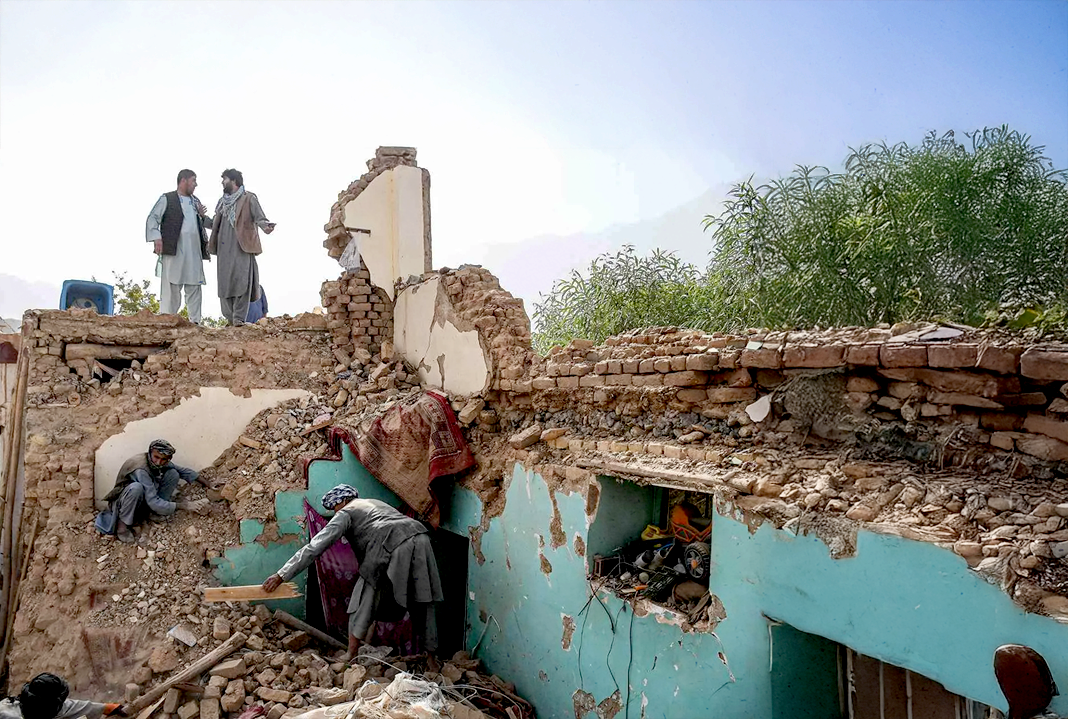
When two major earthquakes hit Afghanistan this year, the physical destruction was devastating, but the deeper crisis stemmed from the deliberate dismantling of the systems that once kept the country safe. The recent disasters in Kunar and Balkh only underscored this reality, revealing how unprepared the country has become when early-warning systems fail, women responders are barred, and aid access is tightly controlled.
As Middle East Uncovered staff writer Ahmad Mansoor Ramizy reports, Afghanistan now faces emergencies with almost no warning infrastructure, a shrinking pool of trained specialists, limited access to affected areas, and a political system that prioritizes ideological control above all.
At the heart of the emergency is a system where expertise has been pushed aside and the institutions responsible for public safety have been gutted.
Afghanistan’s Monitoring Network Has Collapsed
Despite sitting on a major fault line, Afghanistan’s ability to track seismic activity has nearly disappeared. Most of the country’s monitoring stations have gone dark — casualties of sanctions, neglect, and the departure of experienced technicians.
This is part of a broader breakdown in scientific capacity. Universities have lost qualified faculty, science instruction has been downgraded, and classrooms once led by trained educators are now run by men with no background in the subjects they teach.
To add to the war on education, the Taliban have banned more than 400 books deemed in conflict with their ideology, including titles on evolutionary biology, world history, and modern science.
The consequences of these policies become clear in emergencies, when the country lacks the knowledge and tools needed to prepare or respond. The longer scientific understanding is restricted, the harder it becomes to maintain even the most basic disaster-preparedness measures. In practice, this means slower rescues, inaccurate damage assessments, and preventable deaths.
Women Cut Out of Relief Efforts With Predictable Consequences
Female staff are barred from most disaster zones unless labeled “medical personnel.” This cuts off thousands of households that cannot safely receive male responders because women and girls are forbidden from engaging with men outside their immediate family.
This is part of a systemic gendered erasure. The exclusion of women from schools, workplaces, and public life has fractured Afghan society far beyond the symbolic. It has removed half the country’s capacity to teach, report, administer, respond, and rebuild. Disaster relief is no exception: without women on the ground, entire segments of the population simply go unseen and unserved.
How Afghanistan’s Education System Is Being Reengineered
Afghanistan’s vulnerability is not accidental. It reflects decisions that have weakened public bodies and narrowed the space for professional expertise.IBB exposed how the Taliban are reprogramming Afghan youth through an education system centered on ideological obedience rather than learning. Girls and female teachers are cut out of school altogether, while boys are raised in religious boarding schools where the goal is not literacy or critical thinking, but unquestioning submission. A generation of engineers, geologists, medics, and administrators is being replaced by boys trained not for problem-solving, but for obedience.
Relief Efforts Hindered by Taliban Oversight
Aid workers describe how relief groups are slowed by Taliban-appointed “committees” that decide which families qualify for assistance. Access to affected areas is limited, and journalists face strict controls on filming, interviewing, or independently verifying damage.
This dynamic fits the pattern explored in A Nation Gagged, where Afghan journalist Shafi Karimi — now in exile — warns:
In a country where repression reigns, the role of journalists is more critical than ever. Yet, the shrinking space for free media in Afghanistan threatens not only the truth but the very foundation of a democratic society.”
Without independent reporting, transparency collapses and failures repeat unchecked. In the aftermath of the earthquakes, these restrictions made it harder to assess needs, document damage, and provide timely relief.
The Collapse of Expertise Is a Public Safety Issue
The earthquakes made visible what has been eroding for years: Afghanistan no longer has the technical workforce, civic institutions, or information systems needed to respond to major emergencies, and Taliban policies have entrenched that decline. Seismic monitoring has collapsed, early-warning systems are offline, and the departure of trained professionals means even basic assessments now take longer and reach fewer people.
The absence of women in public service compounds these gaps. In large parts of the country, households that require female staff cannot be reached at all. And with journalists restricted from documenting conditions on the ground, relief groups operate with limited data and minimal transparency.
The result is not only a slower response; it’s a country increasingly unable to understand its own risks or recover from them. IBB’s work, from expanding access to scientific material in local languages across the Middle East to supporting independent Afghan educators, is rooted in the belief that people need more than access to information: they need the knowledge and critical thinking required to shape their world. Rebuilding that foundation is essential if Afghanistan is to withstand the crises still to come.