At 4 a.m., Madees Khoury is already inside the brewery, checking the tanks before the rest of the village wakes.
She grew up watching her family manage the business. Now she tests batches and washes down the floors before customers arrive. In the region, no other brewery is run by a woman.
Operating a brewery in the West Bank means navigating checkpoints, supply delays, and layers of permits. For Khoury, it also means answering the same question again and again: why is a woman in charge?
On this International Women’s Day, we’re highlighting several stories from across the region.
A Voice Carried Across Languages
Some stories travel across borders through translation.
Masih Alinejad’s memoir The Wind in My Hair ollows her path from a village in northern Iran to international campaigns challenging the country’s compulsory hijab laws.
The book recounts growing up under regulations that require women to cover their hair in public and punish those who refuse.
Ideas Beyond Borders brought her memoir to Arabic readers. The Arabic edition allows her story—and the debates it raises about autonomy, law, and dissent—to reach a wider audience.

When Schools Closed, Lessons Continued

After the Taliban returned to power in 2021, the boundaries of daily life for women narrowed sharply.
Girls were barred from secondary school and university. For women, most professional jobs disappeared, and parks, gyms, and public bathhouses closed their doors. In many provinces, travel beyond the neighborhood now requires a male guardian.
Recent morality rules go further. Women must not raise their voices in public where unrelated men might hear them, and full-body coverings are required outside the home. The new criminal procedure code allows corporal punishment, assigns less weight to female testimony in court, and gives authorities broad discretion to detain people without strong procedural safeguards.
For many families, the consequences appear in ordinary decisions: whether a daughter keeps studying, whether a household loses its income, whether leaving home risks being stopped.
Classrooms Behind Closed Doors
Yet the ban on girls’ education did not deter women and girls in Afghanistan.
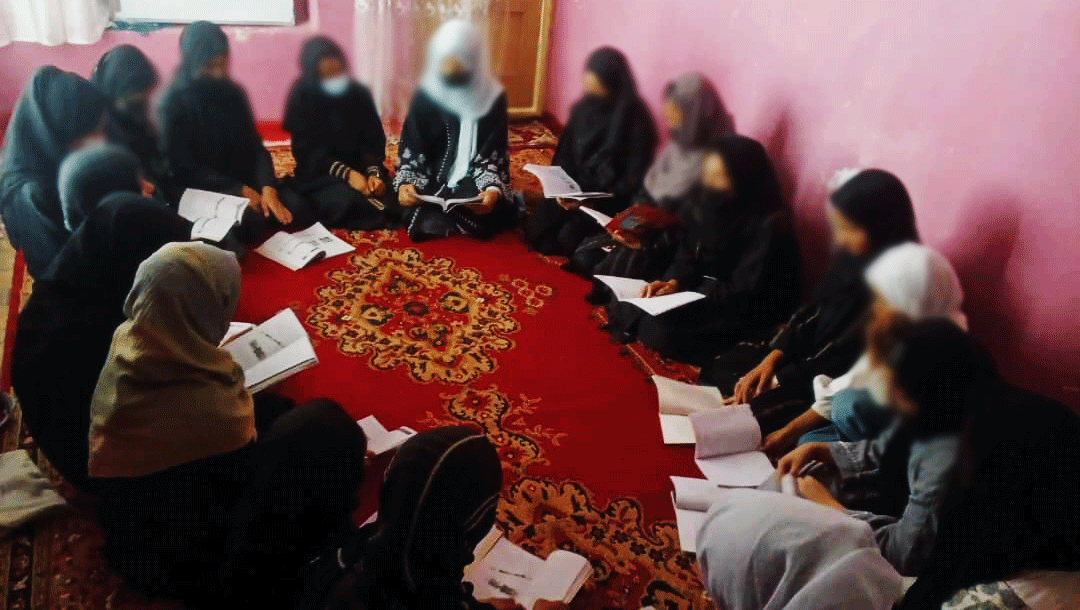
In some neighborhoods, classrooms moved into private homes. Female teachers who can no longer teach boys now instruct girls barred from attending school. Students arrive two or three at a time so neighbors won’t notice a crowd, leaving their backpacks by the door.
One teacher began with just a few students. Word spread quietly through relatives and neighbors. Within months the class doubled, then doubled again.
What began as a handful of lessons in a living room has grown into a network of underground schools serving more than 16,000 students.
Some teachers are barely older than the girls they teach. A few once sat in the same rooms as students, and now they run the classes.

A Workshop Turned Refuge in Beirut
In Beirut, a clothing workshop took on a different role.
Atelier Hartouka was founded in 2018 by Rasha Shukr and Nahida Tawbe, who wanted to create jobs for women struggling to find work as Lebanon’s economic crises deepened. At the atelier, women from refugee camps and low-income neighborhoods produce clothing, bags, and other handmade items.
When airstrikes displaced families in southern Beirut last year, the workshop changed overnight.
Calls began coming in from women who worked with them—some fleeing their homes with only a few belongings. Shukr and Tawbe told them to come to the atelier. Sewing machines and bolts of fabric were pushed aside. Mattresses filled the floor.
From there, the two founders began organizing meals and collecting donations for displaced families. What started as a temporary response grew into a daily operation: cooking in bulk, distributing supplies, and helping families find somewhere to stay.

Standing With Yazidi Survivors
In northern Iraq, another effort emerged after a different catastrophe.
When ISIS attacked Yazidi communities in 2014, thousands of women and girls were abducted and sold into sexual slavery.
Taban Shoresh returned to the Kurdistan Region soon after the attack. A survivor of earlier persecution herself, she left her career in London and began working with displaced families.She later founded The Lotus Flower, an organization supporting women and girls affected by conflict. Its programs now provide education, counseling, and livelihood training to survivors rebuilding their lives.

Inside Jordan’s Parliament
Not every struggle happens out of public view.
Before running for office, Dina Bashir visited the Jordanian parliament building alone to imagine what the job might look like. At 35, she would become one of the youngest women elected to the country’s House of Representatives. Only fifteen women won seats in the 130-member chamber that year.
Winning a seat, Bashir soon discovered, was only the first step. Male lawmakers rely on long-established networks that shape how parliament works. Female MPs often enter without those connections.
“Every day you need to prove that women are capable of performing this role,” Bashir said.
Serving on parliament’s legal committee, she has worked on labor-law reforms, including changes extending maternity leave and expanding the types of jobs legally open to women.

Across the region, women are brewing beer before sunrise, teaching girls behind closed doors, cooking meals for displaced families, rebuilding lives after war, and writing laws in parliament.