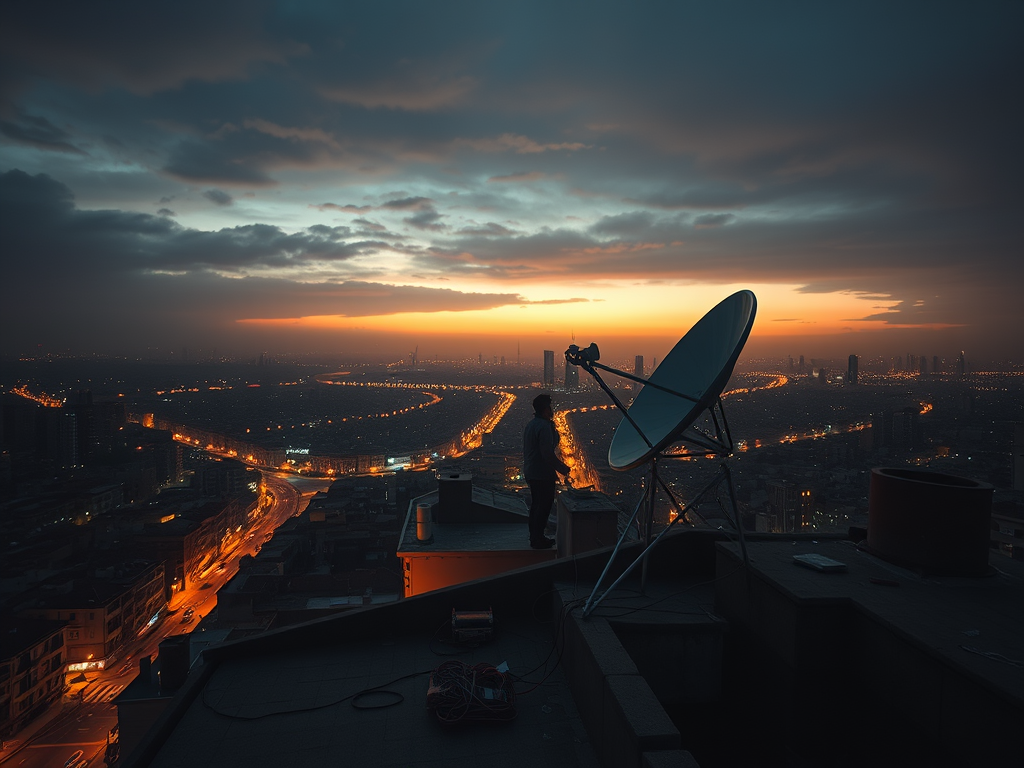
Staying online in Iran now takes nerve and resourcefulness. In backyards, basements, and on rooftops, people are setting up Starlink terminals—small satellite dishes that slip past government filters and quietly reconnect them to the world.
Those caught risk arrest. Still, every new connection chips away at isolation.

For years, Iran has perfected one of the world’s most advanced systems of information control. Entire websites vanish overnight. Messaging apps blink out whenever demonstrations begin. During the 2022 protests, authorities shut down the internet for days. Even then, Iranians found workarounds.That year, Ideas Beyond Borders reported how citizens used VPNs to get around the blackout and keep information flowing.
Now, with Starlink, the barrier is harder to enforce. The dishes are harder to trace, and the signal reaches places the regime cannot fully control.
Knowledge Doesn’t Stay Locked Up

While Iranians confront digital repression with technology, others across the Arabic-speaking world resist it through language itself.
Through IBB’s House of Wisdom 2.0 a network of writers and translators is reviving ideas long buried by authoritarian control. In places where books on science, philosophy, and free thought have been silenced, they’re bringing banned knowledge back into public life.
In Smuggled Wisdom, IBB translator Habib Zreik recalls growing up between Saudi Arabia and Syria, where curiosity could be dangerous. He hid The Iliad, 1984, even a Bible under his bed, dreaming of the day he could talk about them openly. Now he brings those same works into Arabic, helping others break the silence that once shaped his life.
Alissar Obaid, in From Isolation to Enlightenment, writes from a small Syrian town where “knowing too much” was frowned upon. Her translations on science and women’s rights stirred debate even at home; one of her pieces gave her mother a newfound respect for people she disagrees with.
In Literary Liberation, Hazem Mousa describes how translating works of philosophy and science became his way to fight superstition and fear. He calls it “a small light keeping the darkness at bay,” one page at a time.
Rami Abdo Faza shows how every translation sets off a chain of understanding in Words in Motion. After the IBB team brought Free Speech: A History from Socrates to Social Media into Arabic, students in Iraq began debating its ideas in university halls once silenced by state control.
“Translation teaches people how to argue again.”
Ahmed Alesa, IBB translator
And in Knowledge Is the Enemy of Dictatorship, Ahmed Alesa captures the heart of it all: translation, he writes, “teaches people how to argue again.” For him and many others, bringing hidden ideas into Arabic is a form of rebellion.
When the Internet Becomes a Lifeline
Afghanistan faces the same push for access, though by different means.
The Taliban have blocked 23 million websites, monitor online activity, and punish anyone caught accessing banned material. In 2022, IBB exposed how censors were cutting Afghans off from the web. Yet for many young Afghans, the internet remains a lifeline, the only way to study, teach, or earn a living.
In‘Safe Screen Time’ in Afghanistan Means Staying Alive, IBB documented how digital spaces in this part of the world are both a risk and a refuge. A teacher might stream a lesson under a false name. A student might download a physics lecture before the signal drops. Others log on to find freelance opportunities that can be done discreetly and paid from abroad.
The same connection that lets Afghans learn and work also makes it possible to expose what the regime tries to hide. Through online channels, IBB obtained the Taliban’s official blacklist of books — hundreds of banned titles in science, philosophy, and literature. That investigation, The Books the Taliban Doesn’t Want You to Read, revealed what few inside the country could safely say out loud.

Photos of the banned books list
Even under heavy surveillance, Afghans continue to learn, teach, and work in secret. The hunger for understanding and the will to communicate survive every attempt to silence them.
The Will to Know
Control over truth doesn’t end with blocked sites or banned books. It spreads through fear, rumor, and the rewriting of reality.
That’s why IBB supports initiatives that defend factual reporting and open dialogue. Shezomedia trains journalists, strengthens independent media, and challenges extremist narratives in Arabic news; Raza Zan TV gives Afghan women a voice under Taliban pressure, while Bel Arabi fosters open conversations on governance, religion, and reform, broadening access to reliable information in places where misinformation dominates.
IBB also supports groups like Enki Club, a book club carving out space for free speech in one of Iraq’s most conservative cities. “Karbala is so conservative that even people studying physics at university hardly discuss science. All they talk about is religion,” says Hameed, who studies law at the University of Karbala.

Members of the Enki Club in Karbala, Iraq
Through Middle East Uncovered, IBB’s independent journalism platform, we tell stories powerful interests would rather see buried—like that of Mohammed Awchi, who fought back against Iraq’s academic establishment for suppressing free speech—and won.
Together, these efforts reveal a common truth: when people begin to verify facts for themselves, the power of those who depend on distortion starts to fade.
Why It Matters
Across borders and regimes, the same pattern emerges: when truth is silenced, people find ways to make it heard. In Iran, a dish hidden under a rooftop tarp reconnects families to the world. In Syria, a translator quietly restores forbidden ideas to public life. In Afghanistan, a teacher risks everything to stream a lesson.
Each act pushes back against isolation. Together, they remind us that while repression can slow the flow of knowledge, it can never contain it. Truth always finds a way out.